Repeated Reading
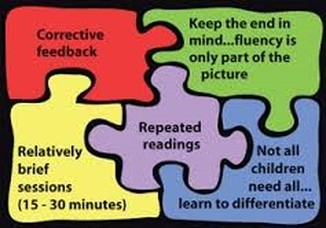
During repeated reading, the student works one on one with a teacher. The student rereads a short passage until a certain level of word identification accuracy and fluency are reached. By having the student repeat the same passage, they are becoming more accurate, speed increases, and their reading becomes more expressive. Usually the passage you select for the student are between 50 and 200 words. The passages should be at the student’s independent or instructional level.
The teacher then times the student for one minute to see how many words per minute they can read. If the student makes any miscues, correct them for the student and have the student repeat them as well for more practice. According to Jennings, Caldwell, & Lerner, 2014, “the repeated reading strategy can be readily adapted to different student needs. To provide more extensive assistance, a teacher can read with the student until he or she feels confident enough to read alone-or students can be asked to listen to their tapes to see if they chunked words into meaningful groups and read with expression.” Something to keep in mind when doing repeated reading with students is to choose a passage the student will be interested in since they will be reading it several times.
The teacher then times the student for one minute to see how many words per minute they can read. If the student makes any miscues, correct them for the student and have the student repeat them as well for more practice. According to Jennings, Caldwell, & Lerner, 2014, “the repeated reading strategy can be readily adapted to different student needs. To provide more extensive assistance, a teacher can read with the student until he or she feels confident enough to read alone-or students can be asked to listen to their tapes to see if they chunked words into meaningful groups and read with expression.” Something to keep in mind when doing repeated reading with students is to choose a passage the student will be interested in since they will be reading it several times.
You could adapt this strategy for many different content areas. For science, you can pick a reading passage from the student’s textbook about fossils or cells. For Social Studies, the passage could be about ancient Greece or westward expansion. According to Jennings, Caldwell, & Lerner, 2014, “repeated reading of content text was a key component of the very successful third-grade intervention.”
